Feng Shui, as a profound ancient Chinese wisdom regarding environment and energy, is not a superstition but an art that studies how to harmonize the energy between people and their living spaces.
Its core lies in the concept of “Qi” (气), a life force that flows through all things.
The fundamental goal of home Feng Shui is to guide and optimize the flow of “Qi” within a residence, thereby creating a harmonious and beneficial “Field” (场) that positively influences the “Fortune” (运) of its occupants.
Many Feng Shui principles align with modern environmental psychology and ergonomics in their underlying logic.
For example, Feng Shui emphasizes light, cleanliness, a sense of security (such as having a solid wall behind a desk or sofa as a “backer”), and avoiding disturbances.
These are not mysterious dogmas but fundamental elements for creating an efficient and comfortable living space. Interpreting the ancient rule that “a desk should not face a window” as “reducing visual distractions to improve concentration” builds a bridge between traditional Chinese wisdom and modern science.
1: The Foundation of Residential Feng Shui: The Qi Mouth and Layout
Before focusing on enhancing specific fortunes like academic or financial luck, one must first ensure the health and stability of the entire home’s energy system. This is akin to constructing a building—the foundation must be solid. In home Feng Shui, the main door and the living room are the two core pillars of this foundation.
1.1 The Main Door: The Mouth of Qi, The Source of Fortune
In Feng Shui, the main door of a residence is known as the “Qi mouth.” It is the central hub for the exchange of energy between the interior and exterior. All Qi fields enter the home through this point, and its condition directly determines the energy tone of the entire dwelling. Therefore, the Feng Shui of the main door is the top priority in all layout adjustments. A dysfunctional “Qi mouth” will lead to an energetically “malnourished” home. Even if the internal wealth or academic positions are perfectly arranged, they will fail to be effective due to the lack of high-quality energy supply.
Core Principles and Taboos:
- Clean and Bright: The area inside and outside the main door must be kept clean and tidy at all times, avoiding clutter or trash. A messy entrance will introduce chaotic Qi, obstructing the entry of wealth and helpful people. Additionally, the entrance should be well-lit, as a bright environment attracts positive, yang energy.
- Avoid Common “Sha Qi” (Negative Energy):
- Facing an Elevator or Stairs: The opening and closing of an elevator and the airflow from stairs can create a pattern of “Qi leakage,” leading to unstable energy in the home that makes it difficult to accumulate wealth.
- Facing a Mirror: Mirrors have a reflective effect. If placed directly opposite the main door, they will reflect incoming wealth and good fortune, causing fluctuating family luck.
- Facing a Toilet or Kitchen: The foul Qi from a toilet and the fiery Qi from a kitchen will clash with the auspicious Qi entering through the main door, polluting the entire home’s energy field and affecting the health of the family.
Auspicious Layout Suggestions:
- Doormat: Place a doormat in an auspicious color, such as red or gold, at the entrance to symbolize welcoming blessings and auspiciousness into the home.
- Plants: Position vibrant green plants, like pothos or snake plants, near the entrance. They are not only aesthetically pleasing but also serve to purify incoming Qi and absorb negative energy.
1.2 The Living Room: The Bright Hall for Qi Aggregation, The Hub of Family Fortune
If the main door is the “mouth and nose” of the residence, responsible for taking in energy, then the living room is its “heart.” It handles the crucial functions of gathering, settling, and distributing this energy to all other rooms. In Feng Shui, the living room is called the “Bright Hall” and is the central hub of family fortune, with its layout directly impacting family harmony, social connections, and overall luck. A crowded, dim, or chaotically arranged living room is like a weak heart, unable to effectively pump life energy throughout the body, leaving functional areas (like the study and bedroom) without adequate nourishment.
Core Layout Principles:
- Bright Hall, Dark Room: This is a core principle of residential Feng Shui. As a public space for receiving guests and family gatherings, the living room requires ample light and an open layout to gather positive, active energy. Bedrooms, as private spaces for rest, should be relatively quiet with soft lighting to facilitate the preservation of Qi and recuperation.
- Sofa with a Backer: The main sofa in the living room should be placed against a solid wall. In Feng Shui, this symbolizes having a “backer,” meaning the occupants will have support from influential people in their careers and lives, providing a stable foundation. If the sofa is backed by a window, door, or walkway, it creates a “no backer” situation, which can make people feel insecure and lead to unstable fortune. This can be remedied by placing a storage cabinet or screen behind the sofa to create an artificial “backer.”
- Square Layout for Smooth Qi Flow: The living room layout should ideally be square or rectangular, avoiding irregular shapes or missing corners. Furniture should be arranged to promote the smooth flow of air and Qi, without causing congestion or obstruction.
- Create a Harmonious Atmosphere: Using warm tones for walls, furniture, or lighting can create a cozy and harmonious family atmosphere, which helps to foster better relationships among family members.
2: Boosting Academic Luck and Examination Success: Precise Location and Enhancement of the Wenchang Position
The Wenchang position is the area that governs academics, wisdom, and achievement. For households with students, individuals facing exams, or those engaged in intellectual work such as writing, creative endeavors, or planning, correctly utilizing the Wenchang position can create an environment conducive to concentration and inspiration.
2.1 What is the Wenchang Position?
“Wenchang” was originally the name of a constellation, popularly known as the “Star of Culture” or “Wenchang Star.” In traditional Chinese culture, the Wenchang star is considered the deity governing literary and academic success, believed to bless scholars with success in imperial examinations. Therefore, finding and utilizing the Wenchang position in a home is like lighting a lamp of wisdom for one’s academic and professional life.
2.2 Precisely Locating Your Three Major Wenchang Positions
There are several methods for locating the Wenchang position, and they are not mutually exclusive. Instead, they can be used in combination to create a more powerful supportive effect. The ideal strategy is to integrate these different layers of favorable factors to construct an optimal magnetic field for learning and work.
- House Wenchang: This is a fixed Wenchang position determined by the sitting direction of the house (the opposite direction of the main door’s facing). It affects the academic foundation of the entire household.
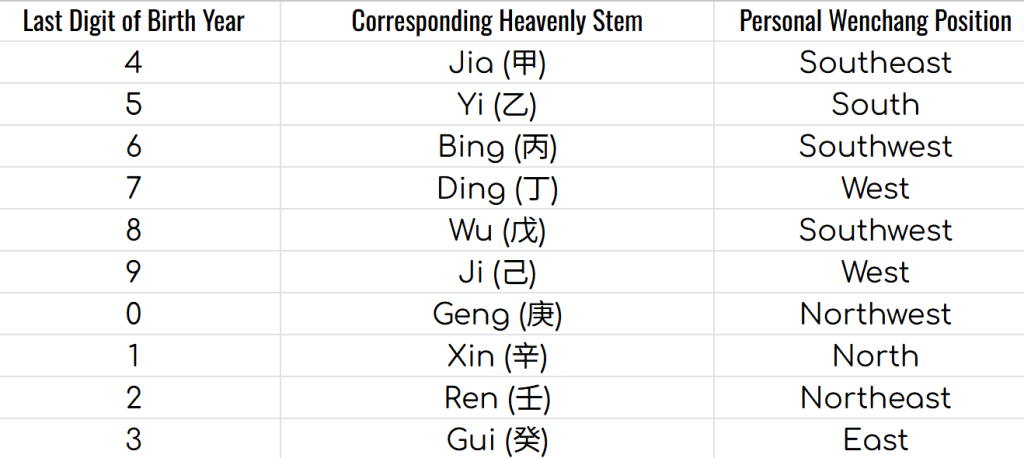
- Personal Wenchang: This is an exclusive Wenchang position determined by the Heavenly Stem of an individual’s birth year, making it most compatible with their personal energy field.
- Annual Wenchang: This is the Wenchang position for the year, calculated based on the “Nine Palaces Flying Stars” theory of Feng Shui. It is timely and often yields quick results. For example, in the year 2024 (Jia Chen Dragon Year), the Annual Wenchang position is in the Northwest.
Optimal Application Strategy:
- Primary Solution: Set up the study or desk in the “House Wenchang” position of the residence. This lays a solid foundation for the academic luck of the entire family.
- Personalized Enhancement: Building on the first step, adjust the orientation of the desk so that the user faces their “Personal Wenchang” direction when seated. This allows the environmental energy to resonate with the individual’s personal energy.
- Timely Activation: Finally, place annual auspicious items, such as a Wenchang Pagoda, on the desk or in the “Annual Wenchang” corner of the room to activate the auspicious Wenchang Qi for the current year, serving as a finishing touch.
Table 2.1: House Wenchang Position Quick Reference Chart
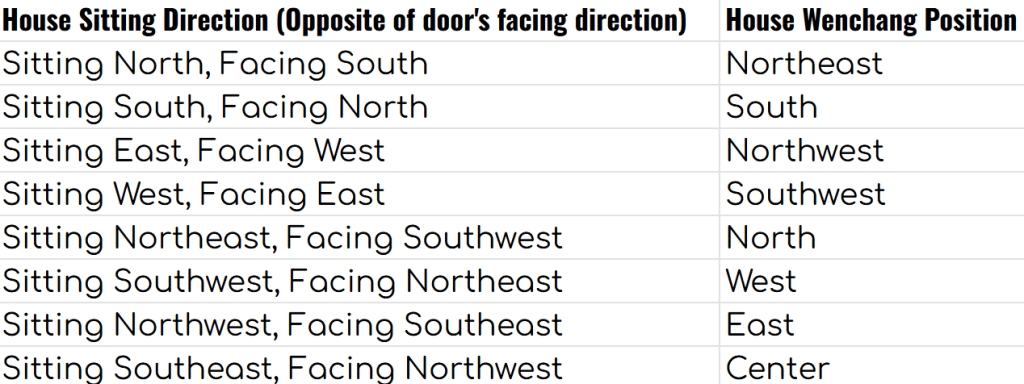
Table 2.2: Personal Wenchang Position Quick Reference Chart
2.3 Optimizing the Layout of the Wenchang Position
After identifying the Wenchang position, the placement of the desk is crucial. This is not just a Feng Shui arrangement but also a best practice for creating a “deep work” environment, designed to minimize cognitive load and subconscious feelings of insecurity through physical setup.
- Desk Placement: The ideal placement is to have the desk facing a solid wall, which helps the user to concentrate without distractions.
Key Taboos:
- Facing a Door or Window: The desk should not directly face a door or window. The movement of people outside the door and the changing scenery outside the window can easily cause distractions.
- Sitting with Your Back to the Door: Having no support behind the seat and directly facing the door can make a person feel insecure and easily startled by movements at the doorway, leading to a restless mind.
- Directly in the Path of a Door or Walkway: The desk should not be in the direct path of a doorway or a walkway within the room. The flowing Qi can disturb the tranquil atmosphere needed for studying.
- Reflection from a Mirror: There should not be a mirror positioned to reflect the user at the desk. The reflection can cause psychological discomfort and make it difficult to sit still and focus for long periods.
3: Gathering Wealth Qi, Boosting Career: Identifying, Arranging, and Avoiding Taboos for the Wealth Position
Financial luck is a key indicator of quality of life. Home Feng Shui aims to create an energy field that attracts, gathers, and protects wealth by identifying and enhancing the “wealth position.” Managing the wealth position requires attention to both “opening sources” (generating income) and “throttling expenditure” (saving), which correspond to the two types of wealth positions in Feng Shui.
3.1 Identifying the Core Wealth Positions in Your Home
There are two main types of wealth positions in home Feng Shui, each with a different function that needs to be treated distinctly. The “Symbolic Wealth Position” can be thought of as the family’s “wealth vault,” responsible for accumulation and stability, while the “Annual Wealth Position” is like the “investment hotspot” of the year, responsible for attracting new opportunities and sources of income. A stable one and a dynamic one—addressing both—constitutes a complete wealth strategy. Focusing only on the annual wealth position while neglecting the symbolic one may lead to wealth coming and going without being retained.
- Symbolic Wealth Position: This is the easiest “symbolic wealth position” to find. It is typically located at the 45-degree diagonal corner from the entrance of the living room or a room, in a spot where Qi can gather and be contained. If the main door opens in the center, both the left and right diagonal corners are considered symbolic wealth positions. This position governs the accumulation and stability of family wealth.
- Annual Wealth Position: This position changes every year according to the Nine Palaces Flying Stars and governs the immediate financial luck and opportunities for that year. For example, in 2024, the number 8 White Star (the primary wealth star) is in the North, while the timely number 9 Purple Star (the future wealth star) is in the Northeast. Therefore, these two areas are the key locations for activating wealth luck in that year.
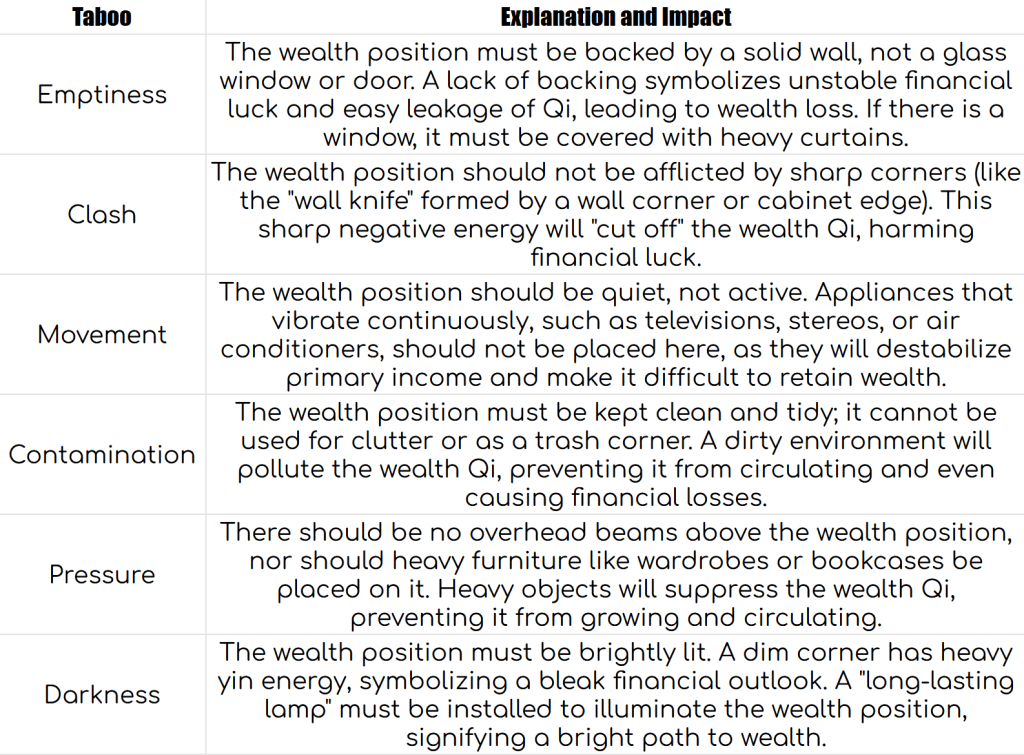
3.2 The Six Major Taboos for the Wealth Position Layout
As the “treasure basin” of the home, the condition of the Symbolic Wealth Position is critically important. The following six taboos are “wealth-damaging” layouts that must be avoided and can serve as a diagnostic checklist for your home’s wealth position.
Table 3.1: Detailed Explanation of the Six Major Taboos for the Wealth Position Layout
4: Attracting Good Fortune and Avoiding Misfortune: Identifying and Resolving Common Home Feng Shui Afflictions
While implementing enhancements, it is equally important to identify and resolve “Sha Qi” (negative energy) in the home. Sha Qi is a negative, destructive form of energy that, if not addressed, will continuously erode the family’s fortune, making all enhancement efforts only half as effective. The core principles for resolving Sha Qi can be summarized in three words: “Block, Slow, and Transform”—that is, using physical barriers to
block, measures to slow down airflow, or specific objects to transform its negative impact.
4.1 Piercing Hall Sha
- Definition: This refers to a situation where the main door is in a direct line with a back door, a balcony, or a large window, causing Qi to flow in through the front and immediately exit through the back. This creates a pattern where “wealth passes through the hall without staying,” and it is considered the number one wealth-draining affliction in Feng Shui.
- Resolution: The core strategies are “Block” and “Slow.” The best method is to install a physical barrier between the main door and the back window, such as an entryway partition, a screen, a tall storage cabinet, or a lush, broad-leaved plant. This forces the Qi to meander and linger within the home instead of flowing straight out.
4.2 Door-Clash Sha
- Definition: This refers to two doors directly facing each other, especially a bedroom door facing a toilet door, a kitchen door, or another bedroom door. A bedroom door facing a toilet door can lead to health issues due to foul Qi; facing a kitchen door can cause arguments due to fiery Qi; and two bedroom doors facing each other can easily lead to disputes.
- Resolution: The core strategy is to “Block.” The most fundamental solution is to reposition one of the doors. If that’s not possible, hang a door curtain (an opaque, long curtain is best) on one of the doors to act as a buffer. Keeping both doors closed is also an effective supplementary measure.
4.3 Form-Based Sha: Wall Knife / Sharp Corner Sha
- Definition: This refers to the corner of an interior wall, the edge of a pillar, or the sharp corner of a large piece of furniture that points directly at a frequently occupied spot, such as a sofa, bed, or desk. This sharp energy can bring about stress, illness, or accidents.
- Resolution: The core strategy is to “Transform.” Place a tall, broad-leaved plant between the sharp corner and the afflicted area to use the plant’s soft life force to dissolve the sharp energy. Alternatively, use rounded furniture or decorations to “smooth out” the sharp corner and change its energy form.
Conclusion: Heaven Rewards the Diligent, and Earth Enhances the Splendor
Home Feng Shui layout is a subtle science of environmental conditioning, with the ultimate goal of creating a harmonious, positive energy field to support the personal efforts of its occupants. This report has systematically explained the core strategies for enhancing academic and financial luck:
- Stabilize the Foundation: First, one must ensure the “mouth of Qi” (the main door) is clean and auspicious and optimize the layout of the “place of Qi gathering” (the living room) to establish a healthy energy circulation system for the entire home.
- Precise Enhancement: Employ a “House, Person, and Year” three-in-one strategy to accurately locate and activate the Wenchang position. Simultaneously, balance the stability of the “Symbolic Wealth Position” with the activation of the “Annual Wealth Position” to achieve both accumulation and growth of wealth.
- Attract Good Fortune and Avoid Misfortune: Proactively identify and resolve common negative energies in the home, such as “Piercing Hall Sha” and “Door-Clash Sha,” to clear the path for good fortune.
It must be emphasized that Feng Shui is a supportive factor, not a deterministic force. It is like a favorable wind that can make a sailor’s journey easier, but the ship’s progress ultimately depends on the efforts of the crew. “Heaven rewards the diligent, and earth enhances the splendor.” A well-arranged, harmonious home (earth’s advantage) can greatly enhance the results of personal struggle (heaven’s reward for efforts).
 Edit A Boat
Leave a comment