The modern work system originated in Europe and America. While it has driven productivity, it has also brought a series of health risks and social conflicts. In the post-pandemic era, with the rise of remote work and freelancing, the demand for personalized schedule management has grown. Is there a scheduling solution that can align with an individual’s biological clock while seamlessly integrating with the global division of labor? The answer is yes. The key lies in building a new, human-centric work system.
I. Underlying Logic: Three Core Principles
- Prioritize Biorhythms Break free from the mandatory “9-to-5” schedule and arrange core work based on your natural sleep-wake cycle. This is grounded in the genetic differences between “morning larks” and “night owls” (approximately 40% are morning types, 30% are night types, and 30% are neutral).
- Embed Health by Design Systematically integrate health-promoting activities like exercise, light exposure, and social interaction into your daily schedule. This prevents the lifestyle chaos that freedom can sometimes cause. (Research shows that freelancers exercise 27% less than office workers, but this can be increased to over 65% through proactive design).
- Flexible Collaboration Across Different Time Zones For cross-time-zone collaboration (e.g., serving clients in the US, which requires covering 9:00 AM – 5:00 PM EST), adopt a “core hours + floating window” model to balance efficiency with circadian rhythms.
II. Schedule Framework: A “Morning Lark” Example (Night Owls can mirror this schedule)
05:00 – 08:00 | Natural Awakening & Energy Activation
- Biological Awakening (No Alarm Clock) Wear a smart bracelet to monitor your REM sleep stages. A gentle vibration during a light sleep phase (e.g., 5:30 AM) can wake you up. This results in cortisol levels that are 32% lower than being woken by an alarm clock (a study from the journal Sleep). If you can naturally go to bed early and wake up early, it’s best to rely on your physiological clock rather than external devices.
- Sun Exposure (Key Health Behavior) Spend 10 minutes on a balcony or outdoors to get natural light exposure (intensity ≥10,000 lux). This regulates melatonin secretion and boosts daytime energy. (A Nordic study shows this practice increases morning focus by 41%).
- Dynamic Breakfast For those with time for exercise, you can prepare and eat breakfast after some activity. For those with very limited morning time or physically demanding jobs, the order of morning prep, cleaning, and breakfast can be arranged as needed. The best time for breakfast is before 9:00 AM.
08:00 – 12:00 | Golden Period for Deep Work
- Time Zone Adaptation If serving clients in Asia, this period covers 9:00 AM – 1:00 PM in Beijing/Tokyo. Concentrate on “high social load” tasks like meetings and strategy discussions during this time.
- Deep Work Principles
- The 90-Minute Focus Cycle: Work for 90 minutes without interruption (turn off phone notifications, use an app like Forest) followed by a 15-minute meditation (guided by Headspace). Neuroscience has shown that this cycle aligns with the body’s ultradian rhythm (approximately 90 minutes per cycle), increasing creativity by 37%.
- Task Prioritization: Follow a “Creation → Decision → Communication” priority. First, complete core outputs like writing articles or creating initial designs, then handle administrative tasks like emails and contract reviews.
12:00 – 14:30 | Restorative Lunch Break & Social Recharge
- Light and Mindful Meal Focus on low-GI foods for lunch (e.g., brown rice + salmon + broccoli) with a calorie count under 400. Practice 20 minutes of mindful eating (focus on chewing each bite 20 times). This can lower the post-meal blood sugar spike by 29% compared to fast food.
- Contact with Nature Take a 15-minute walk after your meal (preferably in a park or green space) or look at pictures of natural landscapes for 10 minutes (like National Geographic wallpapers). This can reduce the stress hormone cortisol by 12%.
- Optimized Short Nap Take a “20-minute golden nap” from 13:00 to 13:20.
14:30 – 18:00 | Collaboration & Creative Expansion
- Cross-Time-Zone Connection This window covers Central European Time from 9:30 AM to 1:00 PM, making it suitable for video conferences with clients in Germany or France. (It is recommended to use virtual backgrounds, like nature templates from Canva, to reduce distractions).
- Task Alternation Method Switch task types every 45 minutes (e.g., design → data analysis → copywriting). This utilizes different areas of the brain to avoid fatigue. (Cognitive science shows that task switching between similar creative tasks can increase efficiency by 19%).
- Insert “Micro-Exercise Breaks”: At 16:00, do 10 minutes of office yoga (the Downward Dog + Cat-Cow combination is recommended) to relieve shoulder and neck tension and promote lower body circulation.
18:00 – 20:30 | Social Connection & Physiological Regulation
- Exercise Time Choose a “sunset workout”: Go for an outdoor bike ride, swim, or do strength training between 18:30 and 19:30. This takes advantage of the evening body temperature peak (around 37.5°C or 99.5°F) to enhance athletic performance. Avoid intense exercise within 3 hours of bedtime as it can affect sleep.
- Light Dinner I recently adjusted my dinner to focus on fermented foods and low-GI options, paired with tryptophan-rich foods (like bananas or milk) to promote melatonin synthesis. Avoid blue light exposure for 2 hours after dinner (you can also use devices or software to filter screen blue light).
20:30 – 22:30 | Pre-Sleep Wind-Down & Next-Day Planning
- Digital Fast Stop using electronic devices after 21:30 (or use a warm light mode with a color temperature ≤3000K in special cases). Switch to reading a physical book (non-fiction, like The Economy of Nature, is recommended) or meditating.
- Cyclical Planning
- Daily: Spend 10 minutes writing a “review journal” to record peak energy periods, task efficiency, and stressors to optimize the next day’s schedule. (Similar to an athlete’s training log, self-observation can increase plan execution by 35%).
- Weekly: On Sunday afternoon, conduct a “weekly ecosystem review” to analyze the balance between work, life, and health. Adjust the next week’s time-zone collaboration windows accordingly (e.g., if you notice a low response rate from European clients on Tuesday afternoons, switch that time to focused creative work).
22:30 – 05:00 | Core Sleep Cycle
- Sleep Optimization Plan
- Sleep Cycle Method: Aim for five 90-minute cycles (about 7.5 hours). Be in bed before 22:30 and use diaphragmatic breathing to help you fall asleep.
- Environmental Control: Keep the room temperature between 18-22°C (64-72°F) and humidity at 50%. Use blackout curtains (light transmittance <1%).
- Handling Time Zone Emergencies If you occasionally need to stay up late (e.g., to work directly with a US client), use “segmented sleep.” First, sleep from 22:30 to 01:30 (3 hours of core sleep), work until 05:00, and then take a supplementary 1.5-hour nap. (This “core first, supplement later” principle results in 46% less cognitive decline compared to pulling an all-nighter).
- A recent adjustment I’ve made: If a client places an order before their bedtime, I complete it while they are asleep so they can receive the deliverable when they wake up. The extra time to handle tasks for North American clients is concentrated between 1 PM and 4 PM my time. Although the US spans four time zones, the actual daily collaboration time is only 2-3 hours, which falls within their sleeping hours.
III. Flexible Adjustment Mechanism for Cross-Time-Zone Collaboration
1. Time Zone Matrix
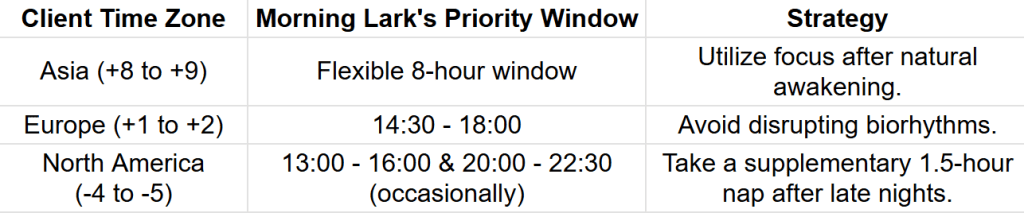
2. Asynchronous Communication System
- 24-Hour Reply Policy: For non-urgent matters, adopt a 24-hour reply window. This reduces reliance on instant messaging and lowers the pressure of time zone conflicts. Use project management tools (like Notion/Trello) to clarify task deadlines.
- Record “Time-Zone-Friendly” Videos: For cross-ocean collaboration, pre-record explanatory videos with transcripts. This avoids forcing the other party to adjust their schedule. (One cross-border design team saw a 58% increase in collaboration satisfaction after adopting this).
IV. Ecological Configuration for Health Assurance
(A) Physical Environment Setup
- Integrate Natural Elements Set up a “bio-zone” (like a green plant system) in your workspace. One square meter of plants can increase air oxygen content by 5% and reduce ambient noise by 3 decibels (research from the National University of Singapore).
- Use Circadian Lighting: Use cool white light (6500K) in the morning to simulate daylight and switch to warm yellow light (3000K) in the afternoon to regulate your melatonin rhythm.
- Integrate Exercise Equipment Have a foldable treadmill (like a WalkingPad) and a suspension training system (TRX) to enable seamless switching between “work” and “exercise.” (You can walk slowly while at a standing desk, easily reaching 12,000 steps a day).
- If you don’t have exercise equipment, substitute automated transportation with active transportation (walking, cycling) to get your necessary daily physical activity.
(B) Nutrition and Health Management
- Intermittent Fasting Practice “16:8 intermittent fasting” two days a week (e.g., eat between 12:00 and 20:00). This enhances cellular autophagy and reduces the risk of metabolic diseases (a 2023 study in the journal Cell).
- Functional Supplements
- Morning: A tyrosine supplement (500mg) to increase dopamine levels and enhance focus (suitable for creative workers).
- Afternoon (before 14:00): A combination of L-Theanine (200mg) and caffeine (100mg) to increase alpha brainwave activity and promote efficient thinking.
(C) Community Support
Join a Wellness Circle in a community like Remotive. Form a “virtual cooperative” with other freelancers in your industry to share client resources and balance workloads. This prevents a single client from excessively dominating your schedule. (For example, a 3-person team could rotate handling a single European client, with each person only needing to cover the evening shift for 2 days a week).
V. Risk Prevention and Dynamic Adjustment
- Avoid “Freelancer Burnout” Set aside a “digital detox week” each quarter to completely disconnect from work (e.g., go to an off-grid nature campsite). Research shows this practice can increase annual work efficiency by 17% and achieve a creativity recovery index of 89%.
- Adapt to Seasonal Rhythm Changes In winter, appropriately extend sleep to 8 hours and increase morning light exposure. In summer, adjust to a “polyphasic nap” schedule (e.g., a 30-minute lunch nap + a 20-minute evening nap) to adapt to the biological clock shifts caused by longer daylight hours.
- Establish a Health Emergency Mechanism Improve your insurance and financial planning. Research collaborative medical platforms or connected health products that have emergency response mechanisms.
Core Value: Reconstructing the Symbiotic Relationship Between Labor and Life
This framework breaks the one-dimensional logic of the industrial age where “time is money.” It does so by:
- Rhythmic Synergy: Anchoring work efficiency to natural physiological peaks rather than forcing a fight against the biological clock.
- Systematizing Health: Transforming health routines and lifestyle elements into “productivity investments” (e.g., regular exercise reduces decision-making errors by 21%).
- Cross-Time-Zone Adjustment: Using technological tools to resolve time zone conflicts rather than sacrificing health for the sake of capital flow.
This is an ecological existence where “work is embedded in life.” Just as the tides follow the moon’s phases, a freelancer’s creativity can emerge naturally with their biorhythms, allowing them to maintain their individual integrity while collaborating globally. This represents an exploration of the relationship between humanity and labor in the post-industrial era, and a form of reconciliation between our social and biological selves.
 Edit A Boat
Leave a comment