All about Time, Direction, and Harmony
Discover the Twelve Earthly Branches (十二地支), the ancient Chinese system that connects time, direction, and wellness. Learn how this relative framework applies to your body, home (Feng Shui), and why it can’t be mapped onto a global grid.
Location is Always Relative: An Introduction to the Twelve Earthly Branches
In traditional Chinese culture, a day is divided into twelve two-hour periods, known as the Twelve Earthly Branches (十二地支, Dìzhī). More than a simple timekeeping method, this system is a profound expression of ancient wisdom. The ancients connected the cyclical changes of Yin and Yang in the universe to develop a unique understanding of natural phenomena and the human self.
This framework suggests that performing specific actions during specific two-hour windows (shichen) allows one to align with the natural flow of the universe, achieving a state of well-being.
Furthermore, the Twelve Earthly Branches correspond to specific geographical directions. This allows one to orient themselves physically and energetically within their environment. While we understand that direction in the physical world is a relative concept, how should we approach the application of this ancient directional system?
The Fixed Directions of the Earthly Branches
The directional system of the Twelve Earthly Branches is built upon a framework of the four cardinal directions, with intermediate directions filling out the compass.
- 子 (zǐ): Corresponds to True North
- 卯 (mǎo): Corresponds to True East
- 午 (wǔ): Corresponds to True South
- 酉 (yǒu): Corresponds to True West
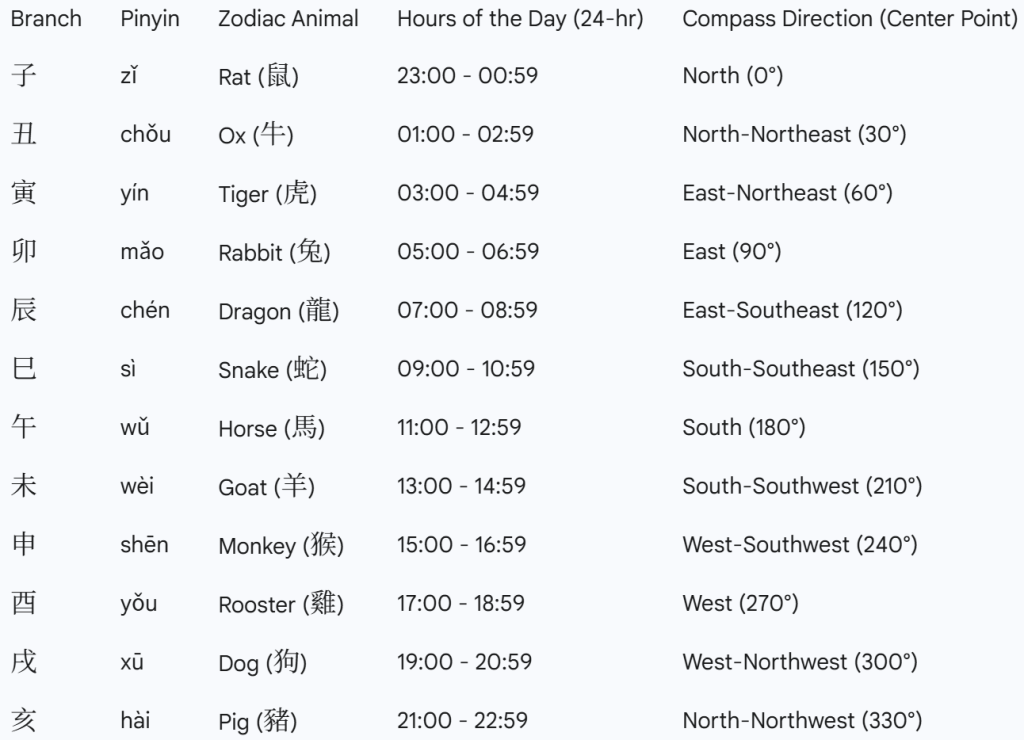
While the system itself is fixed and absolute, its practical application always begins from a specific “center point”—a Taichi Point (太极点)—which serves as the origin of our coordinates. This center point can be an individual, a house, a city, or any other subject of analysis.
The Key to Application: Understanding the “Relative Center”
Using this system is much like using a compass, but with a crucial distinction: each direction is not merely given a name, but is also assigned the symbolic nature it represents. The fundamental method for applying the Twelve Earthly Branches, therefore, is to interpret a physical direction in conjunction with its symbolic meaning.
1. The Individual as the Center
Imagine you are standing in an open square and want to identify the “Mao” (卯) direction. First, you establish your own position as the center. Using a compass or a smartphone, you find True East. That direction, True East, is your personal “Mao” direction. If you walk 100 meters forward, your reference point has moved, but the “Mao” direction (True East) remains the same relative to the new you.
2. The House as the Center (The Basis of Feng Shui)
This is the most common application, central to the practice of Feng Shui. When analyzing the layout of a home, the geometric center of the house is designated as the Taiji Point.
From this central point, you can radiate outwards to determine which Earthly Branch direction the front door, bedroom, kitchen, and bathroom fall into. For example:
- If the front door is in the True East sector, it is said to be in the Mao (卯) direction.
- If the bedroom is in the True South, it is in the Wu (午) direction.
This directional information is then combined with other factors, such as the homeowner’s personal astrology chart (like the Bazi or Eight Characters), to assess fortune and misfortune.
3. The City or Nation as the Center
This concept can be scaled to a much larger geographical scope. For instance, using China’s capital, Beijing, as the center point, Shanghai is located roughly in the Chen (辰) or Si (巳) direction (Southeast). Meanwhile, Ürümqi in Xinjiang province lies in the Shen (申) or You (酉) direction (Southwest/West).
Why Mapping the Earthly Branches to the Prime Meridian is Flawed
Given this system, why can’t we apply it to objective global geography, using the Prime Meridian as a basis for the twelve directions? The reason is that such a division is fundamentally “unreasonable” and contradictory to the system’s core principles.
1. A Fundamental Conflict of Philosophy
- The Twelve Earthly Branches: This system originates from the agrarian and Daoist philosophies of ancient China, reflecting an organic, holistic, and cyclical worldview. It is based on natural rhythms: the sun’s position, the changing of seasons, and the orbital cycle of Jupiter (known in antiquity as the “Year Star”). The North-South (Zi-Wu) axis corresponds to the winter and summer solstices, while the East-West (Mao-You) axis aligns with the vernal and autumnal equinoxes. Every direction and time is imbued with the living, breathing changes of Yin, Yang, and the Five Elements.
- The Prime Meridian: This is a product of the Age of Sail and the Industrial Revolution, reflecting a mechanical, linear, and conventional worldview. Its location (through Greenwich, UK) was determined by political and economic factors. It is an artificial construct, a tool designed for the convenience of global navigation and trade. It is a cold, calculated dividing line, devoid of intrinsic philosophical or vital meaning.
2. A Clash of Models: Radiating Field vs. Dividing Line
- The directional system of the Twelve Earthly Branches is a “field model” that radiates outward from a center (the “中宫,” zhōng gōng). Its core concept is the connection between the center and its periphery.
- The Prime Meridian is a “boundary model” that divides the globe into Eastern and Western Hemispheres. Its function is to separate, not to radiate. To use a dividing line to define a radiating field is a fundamental logical mismatch.
3. A Total Loss of Practical Value
The Twelve Earthly Branches have specific, practical applications within Chinese culture. In Traditional Chinese Medicine (TCM), it guides the flow of Qi in the body’s meridians (the Zi Wu Liu Zhu body clock). In Feng Shui, it determines building orientation. In the lunar calendar, it guides agriculture. All these applications are intrinsically linked to the original, nature-based observations made within China’s specific geography and climate.
A new model based on the Prime Meridian would be completely detached from this cultural and natural context, rendering it devoid of any practical value. It cannot guide the wellness routine of a person in London, nor can it assess the Feng Shui of a building in Ghana.
Conclusion: A Subjective Map vs. A Scientific Grid
Ultimately, the Earth’s spherical surface has no natural, absolute geographical center. Any point can be a center. We can choose the 0° longitude/latitude intersection as a starting point, but this is merely a scientific convention for ease of calculation; it holds no cultural or philosophical “central” meaning. Without a meaningful center, a system of radial directions loses its foundation.
While one could argue for a “hub of civilization” like Istanbul or Central Asia from a collective historical perspective, the Twelve Earthly Branches system would still be inapplicable unless you were physically present at that location.
The Chinese system of Twelve Earthly Branches requires the individual to be the center of their own universe. It is through observing the sun’s rise and fall, the length of shadows at noon, and the turn of the seasons from one’s own relative position that the correspondence between time and space is defined. It is a system that is concrete, experiential, and profoundly human-centric.
 Edit A Boat
Leave a comment