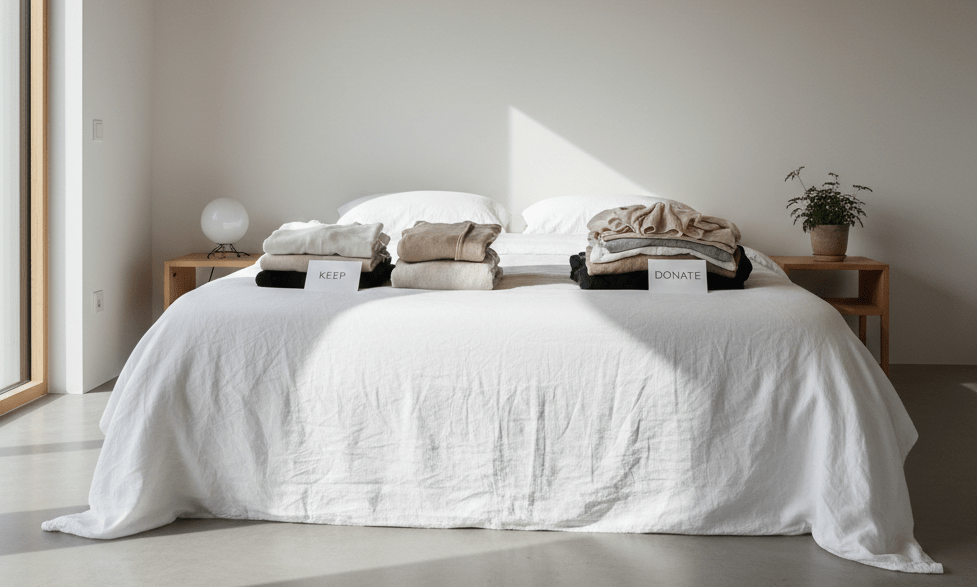
Virginia Woolf once wrote in Orlando, “Clothes have more important offices than merely to keep us warm. They change our view of the world and the world’s view of us.” Your closet holds the story of who you’ve been—those tags still attached, outdated sweaters, dresses that no longer fit—all frozen in time like amber, preserving versions of yourself you haven’t quite let go of.
Here’s the part most guides skip: the right tools don’t create order—your identity does. But the right tools make that identity effortless to live.
TL;DR Quick Start
1. Step 1: Take everything out + sort into 4 piles (Keep / Maybe / Donate-Sell / Trash)
2. Step 2: Let go gently (use a “one-year rule” + a “cost-per-wear” check)
3. Step 3: Zone by real life (work / casual / active / occasion)
4. Step 4: Balance storage (light above, heavy below; hang left/right intentionally)
5. What you’ll need: matching hangers, clear bins, shelf dividers, garment covers, labels
6. Time: 30–90 minutes for a first reset; 10 minutes weekly to maintain
The Hidden Cost of Closet Chaos
Clothes everywhere—on hangers, in storage boxes, draped over sofas and beds. It looks like plenty, but finding what you need feels impossible. When it comes to wardrobe organization, the excuses pile up: small living spaces, too many clothes making organization costly, attachment to memories making it hard to let go. Organizing what’s inside the closet? That feels even more daunting.
I’ll be honest—I once spent 20 minutes tearing apart my closet looking for a specific black turtleneck before an important meeting, only to find it crumpled at the bottom of my laundry basket. I was late, flustered, and ended up grabbing the same tired blazer I always wore. That morning was my wake-up call.
Closet organization isn’t about having fewer clothes—it’s about making what you own easy to see, easy to reach, and easy to put back.
Recognizing the Right Moments to Organize
We don’t lack time for organization—we fail to recognize when it’s needed. Every time searching for clothes delays your plans, when dissatisfaction with an outfit forces a last-minute style change, when closet chaos leads you to grab yet another hoodie on your way out—these are all signals that it’s time to organize. Clothing helps us express our inner selves and project our identity to the world. Organizing your wardrobe brings you closer to the person you want to become in your current life.
Signs You Need a Closet Reset
• You’re late because you can’t find basics
• You rebuy items you already own
• You default to the same hoodie/outfit loop
• Your closet feels “full” but outfits feel “empty”
The “rebuy” thing hit me hard. I discovered I owned four identical white button-downs because I kept forgetting I already had them. Four! That’s when I realized my disorganization was literally costing me money.
6 Powerful Benefits of Wardrobe Organization
1. Save Time: Reduce morning and evening decision fatigue. Retrieving, storing, and coordinating outfits becomes faster and easier.
2. Save Money: Avoid duplicate purchases and curb fast fashion impulses by rediscovering forgotten items already in your closet.
3. Increase Income: Unsuitable clothes can be resold, creating new connections and extra income.
4. Freedom from Worry: Know exactly how many clothes you own. Understand which categories you have enough of—and which pieces belong to a past season of your life, ready to make space for what fits your rhythm today.
5. Maintain Health: Transform your closet from cluttered and cramped to well-organized, giving every garment breathing room.
6. Better Self-Understanding: A refreshed wardrobe helps you reconnect with your core identity and move closer to the person you want to become.
Closet Organization Toolkit (What to Buy, What to Skip)
Think of these tools as gentle scaffolding: they don’t decide who you are—but they make it easier to live as the person you’re becoming.
1) Hangers: Velvet vs Wooden (and Why Matching Matters)
• Velvet: Best for lightweight tops, slip dresses; non-slip, saves space
• Wooden: Best for winter coats, structured blazers; protects shape
• What to look for: Sturdy hook, consistent shoulder shape, slim profile
• Shop: Wide Shoulder Wooden Suit Coat Hangers with Non Slip Pants Bar/ Velvet Hangers/ Solid Wood Coat Hanger
I used to have a chaotic mix of wire hangers, plastic freebies from the dry cleaner, and random wooden ones. Everything kept sliding off and tangling together. Switching to matching velvet hangers was a game-changer—it sounds superficial, but the visual consistency alone made me feel more in control.
For coats that carry memory—the trench coat from your first job interview, the wool blazer worn at your wedding—structure is reverence. I reserve wide-shoulder wooden hangers exclusively for these pieces. The gently curved shoulders prevent shoulder bumps on structured fabrics, while the solid wood texture adds just enough weight to signal: this garment matters.
2) Clear Bins With Lids (The “See It, Use It” Rule)
• Best for: off-season items, accessories, folded tees
• What to look for: Stackable, easy-grip handles, lid that stays shut
• Measure first: closet shelf height + bin depth
• Shop: Stackable Storage Bins with Lids
The paradox of storage: we hide things to “organize,” then forget they exist. Clear bins break that cycle. I use stackable bins with lids that stay shut when pulled from shelves—so seasonal pieces stay visible yet protected, no more forgotten sweaters buried in opaque boxes.
3) Shelf Dividers (Instant Visual Calm)
• Best for: sweaters, jeans stacks, handbags
• Look for: Adjustable clamp, non-slip padding
• Shop: Adjustable Shelf Dividers for Closet Organization with Non-Slip Design
4) Garment Covers / Dust Covers (Protect Without Forgetting)
• 3/4 length: great for “identify by sleeves”
• Look for: Breathable fabric, clear window or label pocket
• Shop: Organic Cotton Garment Storage Bag
I use breathable garment bags with a window for dresses and suits because it lets me identify items by sleeve color alone—no unzipping required. Protection shouldn’t mean invisibility.
5) Pants Hangers / Multi-tier Racks (When Hanging Space Is Tight)
• Best for: Trousers, scarves, belts
• Look for: Non-slip bars, easy access “one motion” retrieval
• Shop: Multi-Layer Clothing Pant Rack for Jeans, Trousers, Skirts, Scarves & Slacks
6) Labels (The Maintenance Hack)
• Labels make your system “returnable” after laundry day
• Options: Label maker vs waterproof sticker labels
• Shop: Phomemo Label Maker
Without them, your system collapses the moment laundry re-enters the closet. A label maker became my anchor—not for perfectionism, but for forgiveness. When I’m exhausted at 11 PM folding laundry, the label “Work Blouses – Left Shelf” means I don’t have to think. Just match the word to the zone.
What to Skip
• Novelty organizers that don’t match your closet dimensions
• Too many tiny categories before you’ve stabilized the main zones
Step 1: Open Your Closet—Gently Confirm “Who Am I”
Before opening your closet, how many pieces of clothing do you think you own? In The Chronicles of Narnia: The Lion, the Witch and the Wardrobe, Lucy opens a wardrobe and discovers another world. A well-organized closet has the magical power to guide you toward your inner world. We come into this world with nothing, and different clothes fulfill our ideal identities at different stages. As our experiences, social roles, relationships, living environments, interests, and aesthetics evolve, our vision of our ideal self undergoes dynamic adjustments.
Now open your closet and take items out one by one, laying them on your bed. Look at coats, undergarments, formal wear, shoes, hats, jewelry, bags, accessories… Among these categories, which do you use regularly?
When I first did this exercise, I guessed I owned maybe 60 pieces. Turns out? I had 143. Seeing everything laid out was overwhelming but also clarifying—I could finally see patterns in what I actually wore versus what I kept “just in case.”
Quick Checklist (20–30 minutes)
• Pull everything onto the bed
• Sort into: Keep / Maybe / Donate-Sell / Trash
• Group “Keep” by category (work, casual, active, occasion)
• Count the top 2 categories you own most (identity clue)
• Take 3 photos: hanging items, folded items, accessories
Common Mistake
• Trying to organize without first seeing the full inventory
If You’re Short on Time (10-minute version)
• Only do one zone today: one drawer, one shelf, or one section of hangers
Step 2: Gentle Letting Go—Release What No Longer Serves You
The clothes you keep align most closely with your core identity. Workplace clothes may reflect your value for structure; abundant athletic gear might signal a desire for movement and exploration. Letting go isn’t loss—it’s making space for who you are today.
A Gentle Decision Framework
• The One-Year Rule: If you haven’t worn it in a year (exceptions: formalwear, true sentimental pieces)
• The Mirror Test: Does it match who you are now—not a fantasy version of yourself?
• Cost-per-wear check: Expensive doesn’t mean meaningful. Calculate: Price ÷ Times Worn. Infinite cost-per-wear (zero wears) means it’s time to release.
I had a designer dress I’d bought on sale five years ago. Never wore it—wrong style, wrong fit for my life. But I kept it because “it was expensive!” Letting it go felt like permission to stop living for an imaginary version of myself.
Quick Checklist (15–30 minutes)
• Try on “Maybe” items for 3 minutes each (timer)
• Create a “Goodbye bag” immediately (donate/sell)
• Write down 1 pattern you notice (e.g., “I buy for fantasy self”)
Common Mistake
• Letting guilt decide (keeping items to “justify” the purchase)
If You’re Short on Time
• Only fill one donation bag; stop there—momentum matters
Step 3: Reasonable Zoning—Let Clothes Flow with Your Life
You should know what you own the moment you open your closet. Everything at a glance.
The 4 Core Zones (Example)
• Daily Basics (closest/easiest reach)
• Work/Occasion
• Active/Leisure
• Off-season / Memory Pieces (highest/least accessible)
My biggest revelation? Realizing I’d been storing my workout clothes in the back of a deep drawer. No wonder I never exercised! Once I moved them to eye level, I actually started using them. Your closet layout can literally change your habits.
Measure Before You Buy (2 minutes)
• Shelf height (so bins fit)
• Closet depth (so hangers + clothes don’t jam the doors)
• Hanging length needed (dresses/coats)
• Door/back panel space (hooks/organizers)
Step 4: Balanced Storage—Make Every Day of Dressing Full of New Expectations
Principle 1: Visual Flow—Create Calm Through Consistency
Your eye seeks rhythm, not randomness. Create gentle visual harmony by grouping similar items with intentional left-to-right flow:
• Left zone: Daily basics (what you reach for 80% of mornings)
• Center zone: Work/occasion pieces (structured, intentional)
• Right zone: Active/leisure (movement-friendly, relaxed)
Why it works: When your closet has rhythm, decision fatigue drops. You’re not searching—you’re selecting.
Principle 2: Light Above, Heavy Below (Top/Middle/Bottom)
• Top: Clear labeled bins (off-season, memory items)
• Middle: Keep it breathable (don’t overcrowd)
• Bottom: Large bins, vertical folding
Finding Your Authentic Self Through Organization
After organizing, you’ll discover you own far more clothes than you realized, and the clothes you kept are more in sync with who you are today. Closet organization isn’t just about storage—it’s about making space for your authentic self.
Three months after my closet overhaul, a friend asked if I’d changed my style. I hadn’t bought anything new—I’d just started wearing the clothes I actually loved instead of defaulting to whatever was easiest to grab. That’s when I realized: organization isn’t about restriction. It’s about making room for who you really are.
Closet Organization FAQ
How do I organize a small closet with no shelves?
Use stackable bins and hanging organizers to maximize vertical space. Measure your closet depth first—many European flats have shallower closets (18–20″) than US standards (24″).
What are the best hangers for saving space?
Velvet hangers are slim, non-slip, and perfect for saving closet space. I use velvet hangers—they create instant visual calm.
How many hangers do I need?
A good rule of thumb: one hanger per hanging item, plus 10% extras for flexibility. For a 50-item wardrobe, start with 55 hangers.
How do I store off-season clothes without damage?
Use breathable garment bags (cotton/polypropylene) for wool/silk. Avoid vacuum-seal bags for delicate fabrics—they compress fibers and cause permanent creasing.
What’s the easiest closet system to maintain?
Opt for adjustable shelves and clear bins to create a flexible, long-lasting system. The key isn’t perfection—it’s a system that survives your worst Tuesday.
How often should I declutter my closet?
Twice a year is ideal—before spring (rotate winter out) and before fall (rotate summer out). Also after major life events: new job, move, relationship change.
Disclosure & Shipping Notes
✨ Heads up: This post contains affiliate links. I earn a small commission if you purchase (at no extra cost to you). I only recommend products I’ve tested and use daily.
⚠️ Shipping times vary by country—check Amazon Global Eligibility before ordering
 Edit A Boat
Leave a comment