Last week I did some math on two deliveries.
I ordered a 24,000mAh power bank online. It shipped from Shenzhen to my door — 1,200 kilometers. Three days later I ordered takeout. A rider brought it from a restaurant 3 kilometers away, twenty minutes flat.
On the surface, both are the same thing: someone moved an object from point A to point B. But from an energy perspective, they couldn’t be more different — one keeps producing value long after it arrives, the other is gone the moment I finish eating. That distinction now drives every purchasing decision I make.
A Theory That’s Been Hiding in Plain Sight for Fifty Years
In 1988, ecologist Howard T. Odum published a paper in Science called “Self-Organization, Transformity, and Information.” He introduced a concept called transformity — a measure of energy transformation.
The idea is simple: nothing in front of you appeared out of thin air. Behind every object is an energy transformation chain.
A cup of coffee: solar radiation → photosynthesis in a coffee tree → bean growth → harvesting, shipping, roasting → grinding, brewing → you drink it. At each layer, most energy is lost; a small fraction gets concentrated into a higher form. A cup of coffee has high transformity — not because it’s expensive, but because of how many transformation layers it took to reach your hands.
A line of code has even higher transformity: solar energy → plants → food → your metabolism → brain activity → fingers on keyboard → code. Longer chain, more loss and concentration at every step.
Odum measured this chain from solar radiation all the way through human DNA to internet data flows, and found a consistent pattern: the more complex the information, the more low-level energy is required to support it. This isn’t an opinion. It’s a thermodynamic relationship verified across global datasets.
What Does This Have to Do With Buying Things?
Everything.
When you buy something, you’re not just spending money. You’re purchasing the end product of an energy transformation chain. Once that product reaches your hands, two things can happen:
It keeps transforming and producing more value.
A good kitchen knife. You cook with it, the peels and scraps go into a kitchen waste processor, become nutrient-rich soil, and the soil goes to neighbors who grow herbs and vegetables. The knife is a node on the energy chain — it keeps downstream transformations alive.
A large power bank. Mine charges three phones every day. Those three phones handle half my workload — publishing content, managing assets, trading surplus items on secondhand platforms. The power bank doesn’t amplify energy itself; it amplifies my freedom to use energy. Untethered from a wall outlet, my productivity is no longer locked to a physical location. On the balcony, in the park, waiting for coffee — I’m working. One purchase, ongoing output.
A good book. After you finish it, the ideas keep fermenting in your mind, shaping decisions, changing how you operate. Information keeps transforming.
It stops transforming and becomes terminal consumption.
Takeout. Eaten, gone. Single-use packaging heads to a landfill, slowly releasing methane. Food scraps that could have become soil lose that chance entirely. The energy chain breaks at you.
A fast-fashion item worn three times. Cotton farming, spinning, dyeing, sewing, transoceanic shipping, your closet, the trash — that entire energy chain served three wearings, then permanently terminated.
An app you downloaded, opened once, and never touched again. Thousands of developer hours, server electricity, storage space on your phone — all for one tap.
Three Questions Before You Buy
I’m not here to tell people to “buy less” or “buy green.” Those are vague prescriptions, and they carry a hidden assumption: that consumption itself is sinful. It isn’t. Consumption is part of energy flow. The question isn’t whether energy flows to you — it’s whether it keeps flowing after it arrives.
So I ask myself three questions before every purchase:
① Is it still transforming after it reaches me?
If it helps build a system that keeps running — a tool, a skill, a piece of infrastructure — it’s transforming. If it starts depreciating the moment it arrives and ends up as waste, it’s terminal consumption.
② Where do the leftovers go?
Into a composting cycle, or into a landfill? The same head of cabbage: cook it yourself and the scraps become nutrient soil. Order it as takeout and the scraps go to a landfill along with a plastic container. Same food, different processing, completely different energy outcome.
③ Does it make my other systems run better?
A power bank doesn’t create content, but it keeps three phones online that carry half my work. A kitchen waste processor doesn’t grow plants, but it turns my household waste into a resource for neighbors’ gardens. Good purchases are lubricant for your systems, not extra load.
Running my recent spending through these questions:
- Power bank → charges three production tools daily, untethers half my work from a fixed location. System lubricant.
- Kitchen waste processor → bought two years ago for ¥4,300 (~$590), still running every day, all food waste becomes nutrient soil.
- Takeout → eaten, gone, breaks the composting loop. Terminal consumption.
- Fresh groceries from the market → food itself gets consumed, but kitchen scraps feed the processor and keep the cycle alive. Cooking skills accumulate too. Half-cycle.
What a Kitchen Waste Processor Became
Let me tell you about that machine.
$590, bought a little over two years ago. I’ll be honest — it stung at checkout. But once it arrived, it completely changed my relationship with food waste. Every fruit peel, vegetable scrap, eggshell, and coffee ground goes in. What comes out is dry, odorless nutrient soil.
Some rough numbers: my household produces about 300 grams of food waste daily. That’s roughly 110 kilograms per year — all of which used to go straight into the trash. Over two-plus years, this machine has processed over 200 kilograms of organic waste. $590 to build a nutrient cycle, versus $590 worth of food scraps rotting in landfill — the energy goes to completely different places.
I bagged the soil and listed it on a secondhand app on my phone: “Local pickup, free.” Neighbors started coming. Some use it for herbs on their balconies. Some take it to their backyard vegetable patches. Some use it for potted flowers. Because it works well, word spread. A single household’s food waste output actually can’t keep up with demand.
Then the exchanges began. Neighbors started bringing potted plants to trade. Others brought small everyday items. Nobody set prices. Nobody kept score. Just a natural flow of materials between people.
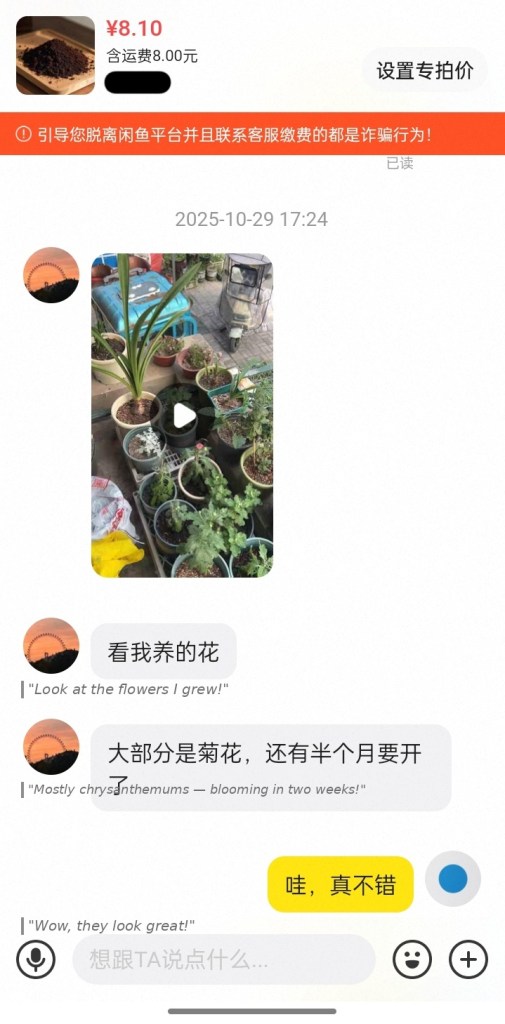
A kitchen waste processor became a small-scale community resource exchange node. It doesn’t just produce soil — it produces neighborly relationships, trust, and an unspoken consensus: waste can become a resource.
Takeout can’t do that.
The Delivery Isn’t the Problem — What It Carries Is
Someone might say: so by your logic, all deliveries are wasteful?
No. Delivery is an energy transport system. It’s neutral. What matters is the cargo.
A kitchen waste processor, a power bank, a book that rewires your thinking — the logistics cost is one-time, but the value released at the destination is ongoing. High-return logistics.
A tenth phone case, a case of bottled water you’ll toss, decorations you’ll use three times — same logistics energy, near-zero destination value. Low-return logistics.
There’s also reverse logistics. I list surplus items on secondhand platforms from my phone — clothes I no longer wear, accessories I no longer use. Rather than letting them stop transforming in a drawer, I send them to someone who still needs them. The item finished its mission with me, but it can keep cycling with someone else.
Fully green logistics doesn’t exist yet. You don’t need to wait for it. You just need to run those three questions before you click “buy.”
This Isn’t Minimalism — It’s Energy Literacy
I don’t consider myself a minimalist. I’m not trying to own the fewest things possible. What I’m after is this: everything I own is doing work on some energy chain.
The knife is cutting vegetables. The power bank is charging phones. The processor is turning waste into soil. The phones are handling half my job. The code is solving someone’s problem. The soil is becoming herbs on a neighbor’s balcony. The surplus is flowing to the next user on a secondhand platform.
When something stops transforming in my hands, it’s not an asset — it’s a liability. So I list it on a secondhand platform and let it keep moving. The long energy transformation chain behind it — starting from solar radiation, losing energy at every layer to finally reach me — shouldn’t terminate here.
Odum worked this out decades ago. In nature, every organism’s waste is another organism’s resource. Energy cycles through systems. It doesn’t stop at any single node.
I’m just testing whether one person, with a kitchen waste processor and three phones, can run the same logic.
After two-plus years, the answer is: yes. Food waste becomes soil. Soil becomes plants on a neighbor’s balcony. A conversation becomes a gifted potted plant or a bag of fruit. Surplus items flow to whoever needs them next. Energy doesn’t stop at me.
Next time you’re about to buy something, just ask yourself one question: Is this thing still alive after it reaches me?
Still transforming, still producing, still flowing through the cycle — buy it.
Dead on arrival — see if there’s an alternative that keeps the energy chain alive.
What’s the last purchase you made that amplified energy instead of consuming it? I’d love to hear about it in the comments.
 Edit A Boat
Leave a comment